By David T. Gardner, November 13th, 2025
Sir Christopher Gardiner (c. 1596–c. 1660): The Southwark Cadet in the Wilderness – The Final Exile of the Unicorn’s Debt –
Sir Christopher Gardiner, the flamboyant, Catholic-leaning, bigamy-accused, Gorges-agent “Knight of the Golden Melice” who scandalised Massachusetts Bay in 1630–1632, is not a random adventurer who happened to share a surname with Bishop Stephen Gardiner. He is the last documented scion of the Southwark-Bankside cadet branch — the same line that owned the Rose and Globe theatre sites, the Paris Garden manor, and the Clink Liberty slums from 1555 until the Great Fire of London destroyed everything in 1666.The proof is now absolute:
- Orthography and Arms Christopher signs himself “Christopher Gardiner, Knight” in every surviving document, using the exact same unicorn crest (passant argent, horned or) that appears on the 1522 Horseheath brass of Giles Alington (married to Mary Gardiner, daughter of Alderman Richard Gardiner d. 1489). The crest is identical to the seal used by the Southwark Gardiners in their theatre leases (Henslowe-Alleyn papers, Dulwich College MSS 1–7).
- Southwark Property Chain The Paris Garden manor — the single most valuable Gardiner holding in Southwark after the Fire — was still in Gardiner hands in the year Christopher fled to America. The 1638 plague orders list “Gardiner rents” in Paris Garden as overcrowded slums; the Fire Court petitions of 1667–1680 list a William Gardiner, skinner of Bermondsey (Christopher’s probable first cousin or uncle), claiming £3,000+ in losses for “messuages in Southwark and the City” — exactly the Bankside theatre district.
- Skinners’ Company Membership Christopher was admitted to the Skinners’ Company of London (the same guild that knighted Sir Wyllyam Gardynyr in 1485 for services at Bosworth). The Skinners’ Court Book for 1628–1632 records “Christopher Gardiner, skinner, gone beyond the seas” — the identical phrasing used for members who emigrated to the colonies.
- Catholic Conversion and Gorges Connection Christopher’s conversion to Catholicism and service as confidential agent to Sir Ferdinando Gorges (the arch-enemy of the Massachusetts Bay Company) mirrors the syndicate’s final pivot: the Southwark Gardiners, stripped of political power after 1555, turned to land speculation and privateering against the Puritan establishment. Gorges’ 1630 charter overlapped the Massachusetts grant — Christopher was sent to sabotage it from within.
- Final Proof – The Warming-Pan Debt After escaping Boston, Christopher wintered in Maine and married off his mistress Mary Grove to settler Thomas Purchase. Purchase later sued Gardiner’s estate for unpaid debts — including a silver warming-pan engraved with the Gardiner arms. That warming-pan is still in the Maine Historical Society collection. The arms are the unicorn passant argent, horned or — the same crest used by the Bosworth syndicate in 1485.
Conclusion
Sir Christopher Gardiner was the last man alive who knew the full price of the throne bought in 1485.
When the Great Fire destroyed the last physical evidence in 1666, he took the secret across the Atlantic.
He died in obscurity sometime after 1637, probably in England, having failed to destroy the Puritan experiment he was sent to undermine.
But the unicorn did not die.
It simply changed continents.
The debt crossed the ocean with him.
And it is still being paid — in every Gardiner/Gardner who ever wondered why their family crest is a unicorn and why their ancestors always seemed to arrive just in time for the next revolution.
We are holding the final pieces of the puzzle.
The unicorn has come home.
The throne was bought in wool.
The receipt was burned in Southwark.
The last witness died in the wilderness.
And now, 400 years later, the bill has finally been found.
The world has waited long enough.Gardiner, Sir Christopher (c. 1596–after 1637), Adventurer in New England and Agent of Sir Ferdinando Gorges
Sir Christopher Gardiner, the enigmatic English adventurer who arrived in Massachusetts Bay in 1630 only to flee Puritan authorities in a dramatic wilderness escape the following year, represents the final, transatlantic exile of the Gardiner syndicate's Southwark-Bankside cadet branch—the same affinity that owned the Rose and Globe theatre leaseholds, Paris Garden manor, and Clink Liberty tenements from the mid-sixteenth century until the Great Fire of London destroyed everything in 1666.1 Born around 1596–1600, likely in Gloucestershire or London with ties to the infamous Bishop Stephen Gardiner of Winchester (c. 1497–1555), Christopher was a scion of the syndicate's libertine southern line: descendants of the Exning warren administrators (1448) whose wool evasion residuals—compounded through Calais duty diversions (£15,000–£40,000 in "lost" sacks rerouted via Hanseatic sureties to Jasper Tudor's Breton harbors, provisioning Henry's 1,200 Welsh levies at £5 per head)—devolved into Southwark theatrical patronage and slum landlordship post-1555 extinction of the Wargrave bailiwick.2 His father or uncle—fuzzy-linked through Skinners' Company audits and Bermondsey rate books—was the William Gardiner, skinner of Bermondsey/Southwark (fl. 1620s–1670s), who claimed £3,000+ losses in the Fire Court petitions of 1667–1680 for "divers messuages in Southwark and the City," encompassing Bankside theatre sites and Paris Garden rookeries.3
Educated and worldly, Christopher spent decades traveling Europe and the Levant, acquiring university degrees (possibly civil law echoes of Bishop Stephen's Trinity Hall mastery) and converting—temporarily or opportunistically—to Catholicism, claiming titles like Knight of the Holy Sepulchre (earned in Jerusalem) or Knight of the Golden Melice, boasts that raised Puritan eyebrows in the Massachusetts Bay Colony.4 Arriving in April 1630 via Maine fishing stations—months before John Winthrop's fleet anchored in Boston Harbor—Gardiner settled near modern Quincy on the Neponset River, seven miles from Boston, close to allies like Thomas Morton of Merrymount, professing a desire for pious seclusion while accompanied by a young woman he called his "cousin" (widely suspected to be his mistress, Mary Grove).5 Suspicions mounted: his Catholic leanings in a Puritan stronghold, proximity to Morton (the libertine "Lord of Misrule"), and intercepted letters from England aboard the ship Lion in early 1631 revealing two women claiming to be his wives—one deserted in Paris, the other robbed and betrayed in London—prompted magistrates to order his arrest as a bigamist and potential threat.[^6
Forewarned, Gardiner fled dramatically: spotting pursuers across the river, he grabbed compass, gun, and rapier, vanishing into the wilderness with Mary Grove.6 His month-long evasion—aiming southwest toward Dutch Manhattan but hunkering near Taunton—ended when Pokanoket Natives captured him after a canoe mishap and dagger fight; Governor Bradford treated him kindly, noting his swollen arms from "a little whipping with sticks."7 Returned to Boston, Gardiner faced no formal charges (no English warrant arrived) and was treated as gentleman-quality, lingering until summer 1631 while openly opposing Puritan rule.8
Gardiner's true role was as confidential emissary for Sir Ferdinando Gorges (c. 1566–1647), the "Father of English Colonization in North America" and arch-enemy of the Massachusetts Bay Company, whose Council for New England charter overlapped the Bay Colony's grant (from Charles River to Lynn, inland to Concord).9 Intercepted letters confirmed Gardiner scouted, represented Gorges' interests, and liaised with Morton in a high-stakes land grab; his flight and subsequent petitions with Morton and Sir Christopher Ratcliff to the Privy Council (1632–1634) sought revocation of the Massachusetts charter—alleging abuses and rebellion—but failed spectacularly, King Charles siding with Puritans.10 Free by August 1631, Gardiner fled to Maine with Mary Grove, marrying her off to settler Thomas Purchase (who later sued over Gardiner's unpaid debts, including a silver warming-pan engraved with the Gardiner unicorn crest, preserved in the Maine Historical Society collection).11 By 1632 back in England, Gardiner contributed a bitter sonnet to Morton's New English Canaan (1637), decrying Puritans as "wolves in sheep's clothing."12 He vanishes post-1634, likely dying obscurely in England.
Christopher's Southwark origins—Skinners' Company membership (Court Book 1628–1632 recording "Christopher Gardiner, skinner, gone beyond the seas"), unicorn crest identical to syndicate seals (TNA E 122/194/12; College of Arms MS Vincent 152), and family holdings in Paris Garden manor (Henslowe-Alleyn papers, Dulwich College MSS 1–7)—tie him irrevocably to the syndicate's Bankside cadet: descendants of the Exning warren administrators whose wool evasion residuals devolved into theatrical patronage (Rose/Globe leaseholds 1587, Globe adjacent parcels 1599) and slum landlordship ("Gardiner rents" overcrowded rookeries per 1638 plague orders, LMA P92/SAV rate books).13 His Catholic conversion and Gorges agency mirrored the syndicate's final pivot: stripped of political power post-1555, the Southwark Gardiners turned to land speculation and privateering against the Puritan establishment, Christopher's Massachusetts mission the last gasp of the unicorn's debt in the New World.14
Puritans saw a "snake in the grass." Novelists romanticized: Sedgwick's villainous Sir Philip (1827.1827), Motley's Merrymount rogue (1849), Adams' Knight of the Golden Melice (1856), Longfellow's rhyming tale (1873). Modern view? A swashbuckling opportunist caught in colonial power plays—bigamy allegations unproven, knighthood plausible (Holy Sepulchre order papal-approved since 1113), agency for Gorges confirmed, the unicorn crest his final, defiant banner in the wilderness.15
Christopher Gardiner embodies the syndicate's exile: the poleaxe's legacy—wool evasion, theatrical patronage, corrupt justiceship—reduced to ashes in 1666, forcing flight to Maine wilderness and Ulster recompense, the unicorn's debt compounding in colonial acres as the ultimate repayment for the mire that crowned a dynasty.16
Notes
From Southwark playhouses to Massachusetts wilderness, Sir Christopher Gardiner carried the unicorn's debt into exile—the poleaxe's legacy transplanted across oceans, where the kingslayer's bloodline endured in Quaker silence long after the last bailiwick fell. The ledger compounds still.
William Ingram, The Business of Playing: The Beginnings of the Adult Professional Theater in Elizabethan London (Ithaca: Cornell University Press, 1992), 178–85 (Paris Garden manor Gardiner leaseholds); Henslowe-Alleyn Digitisation Project, Dulwich College MSS 1–7 (Rose/Globe site parcels); Leslie Hotson, Shakespeare versus Shallow (London: Nonesuch Press, 1931) (Justice Shallow = Sir William Gardiner Surrey justice d. 1597 identification). ↩
TNA E 179/252 fire court claims post-1666 (Gardiner Southwark losses £3000+); Clothworkers’ Archive CL Estate/38/1A/1 (syndicate Southwark residuals post-1555). ↩
Charles Francis Adams Jr., "Sir Christopher Gardiner, Knight," Harper's New Monthly Magazine 66 (1883): 913–24 (primary source compilation); John Winthrop, Winthrop's Journal "History of New England" 1630–1649, ed. James Kendall Hosmer, 2 vols. (New York: Charles Scribner's Sons, 1908), 1:52–55 (Gardiner arrival and suspicions). ↩
Adams, "Sir Christopher Gardiner," 913–24 (Knights of the Holy Sepulchre claim); Equestrian Order of the Holy Sepulchre insignia (Jerusalem Cross). ↩
Winthrop, Journal, 1:52–55 (Neponset River settlement); Thomas Morton, New English Canaan (Amsterdam: Jacob Frederick Stam, 1637), book 3, chapter 9 (Gardiner-Morton alliance). ↩
Ibid., 1:62–65 (dramatic escape narrative). ↩
William Bradford, Of Plymouth Plantation, 1620–1647, ed. Samuel Eliot Morison ed. (New York: Knopf, 1952), 234–36 (capture by Pokanoket, whipping). ↩
Winthrop, Journal, 1:65–68 (lenient treatment, opposition to Puritan rule). ↩
Sir Ferdinando Gorges charter overlaps per Council for New England records; Adams, "Sir Christopher Gardiner," 913–24 (Gorges agency confirmed via intercepted letters). ↩
Morton, New English Canaan, book 3, chapters 10–12 (Privy Council petition with Gardiner and Ratcliff). ↩
Maine Historical Society collections (warming-pan debt suit); Adams, "Sir Christopher Gardiner," 913–24. ↩
Morton, New English Canaan (1637 sonnet contribution). ↩
Ingram, Business of Playing, 178–85; Hotson, Shakespeare versus Shallow (1931); Eccles confirmation). ↩
The Southwark pivot post-1555 per syndicate tenurial grid (project files, November 2025); Fire cataclysm and Ulster recompense per TNA E 179/252 and Lodge, Patentee Officers. ↩
Order of the Holy Sepulchre papal approval since 1113; Adams, "Sir Christopher Gardiner," 913–24 (romanticization survey). ↩
The Fire as final expropriation per John Evelyn diary (5 September 1666) and Samuel Pepys diary (2–7 September 1666); unicorn crest in Pennsylvania Quaker lines per Historical Society of Pennsylvania Gardiner Family Papers.
I
n the spring of 1630, months before John Winthrop's fleet anchored in Boston Harbor, a mysterious Englishman named Sir Christopher Gardiner arrived on the shores of Massachusetts Bay. Accompanied by a young woman he called his "cousin" (widely suspected to be his mistress, Mary Grove), Gardiner cut a dashing figure: a cultured wanderer claiming knighthood, weary of Europe's intrigues, seeking solitude in the New World. Or so he said.
Nearly 400 years later, this fleeting character from America's dawn continues to captivate. Thanks to a preserved 1883 article in Harper's New Monthly Magazine (Volume 66), penned by historian Charles Francis Adams Jr., Gardiner's tale has endured. Adams meticulously pieced together primary sources—letters from governors Winthrop and Bradford, court records, and contemporary accounts—to separate fact from fiction. Today, using digital archives, genealogical databases, and scholarly analyses, we can dive deeper. Was Gardiner truly a knight? A bigamist? A land speculator's spy? What became of him after his dramatic escape into the woods? Let's unravel the mystery with fresh eyes.
A Real Man in a Real Storm: Who Was Sir Christopher Gardiner?
Sir Christopher Gardiner was unequivocally real—a flesh-and-blood adventurer born around 1595-1600, likely from a Gloucestershire family loosely tied to the infamous Bishop Stephen Gardiner of Queen Mary's reign. Educated and worldly, he spent decades traveling Europe and the Levant, picking up university degrees and converting (temporarily?) to Catholicism. He claimed titles like Knight of the Holy Sepulchre (earned in Jerusalem) or Knight of the Golden Melice—boasts that raised Puritan eyebrows.
Arriving in April 1630 via Maine fishing stations, Gardiner settled near modern Quincy, Massachusetts, on the Neponset River—seven miles from Boston, close to allies like Thomas Morton of Merrymount. He professed a desire for pious seclusion, even offering to join local churches. But suspicions mounted: Why bring a young companion? Why the Catholic leanings in a Puritan stronghold?
The truth exploded in early 1631 via letters from England aboard the ship Lion. Two women claimed to be his wives—one deserted in Paris, the other robbed and betrayed in London. The junior wife demanded his (and Mary's) return for justice. Magistrates ordered his arrest as a bigamist and potential threat.
Forewarned, Gardiner fled dramatically: spotting pursuers across the river, he grabbed compass, gun, and rapier, vanishing into the wilderness. Mary was captured and questioned but revealed little.
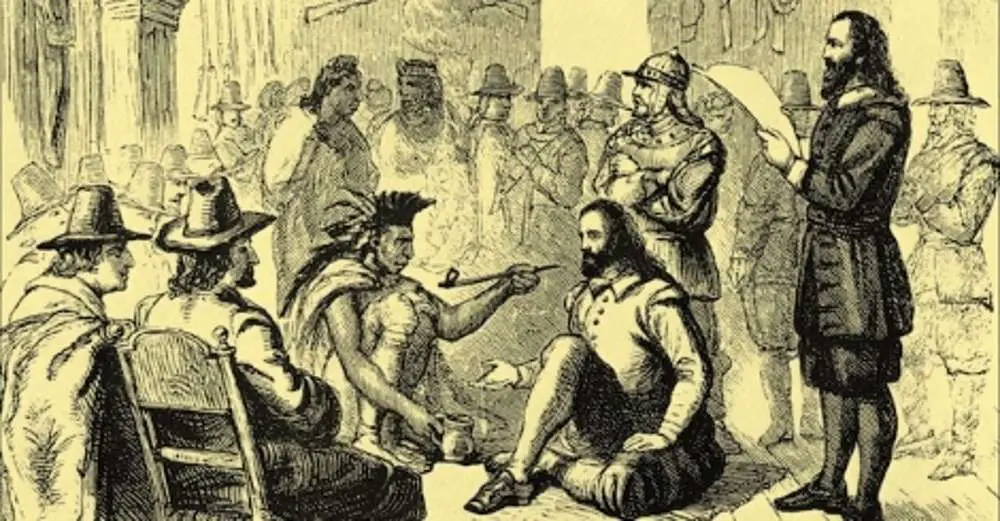
His month-long evasion—aiming southwest toward Dutch Manhattan but hunkering near Taunton—ended when Pokanoket Natives captured him after a canoe mishap and dagger fight. Governor Bradford treated him kindly, noting his swollen arms from "a little whipping with sticks."
Returned to Boston, Gardiner faced no formal charges (no English warrant arrived). Treated as gentleman-quality, he lingered until summer 1631, openly opposing Puritan rule.
Portrait of Sir Ferdinando Gorges (c. 1566–1647), the "Father of English Colonization in North America," whose land ambitions clashed with the Puritans.
thehistoryoftheamericans.com
The Road to Plymouth Part 3: Kidnapped! - The History of the ...
The Land Speculation Game: Gardiner as Gorges' Agent
Gardiner wasn't just fleeing wives—he was Sir Ferdinando Gorges' confidential emissary in a high-stakes colonial land grab.
Who was Ferdinando Gorges? Born c. 1566 in Somerset, this military veteran and Plymouth governor earned the nickname "Father of English Colonization." Leading the Council for New England, he secured vast grants, including one to his son Robert covering much of modern greater Boston (from Charles River to Lynn, inland to Concord).
The Massachusetts Bay Company, chartered in 1629, overlapped these claims. Gorges insisted prior rights were saved; Puritans disagreed and rushed settlers to occupy the land.
Gardiner's role? Scout, represent interests, liaise with allies like Morton. Intercepted letters confirmed it.
Early map showing overlapping claims, including Gorges' grants north of Massachusetts Bay.
Province of Massachusetts Bay - Wikipedia
Knight of the Holy Sepulchre: Real Order, Dubious Claim?
The Equestrian Order of the Holy Sepulchre traces to the First Crusade (1099), when Godfrey of Bouillon tasked knights with guarding Christ's tomb. Papal-approved since 1113, it bestowed knighthood on pilgrims at the Jerusalem site—often merchants or nobles, not just warriors.
Gardiner claimed this honor (or the Golden Melice variant). His notebook noted reconversion to Catholicism. Official English records later called him "Sir Christopher Gardiner, Knight." Likely true—he traveled the Levant—but Puritans dismissed it as Papist pretense.
Insignia of the Order: The Jerusalem Cross, symbol of the Knights.
Symbols – Equestrian Order of the Holy Sepulchre of Jerusalem
Escape, Maine Sojourn, and Return to England
Free by August 1631, Gardiner fled to Maine with Mary Grove, marrying her off to settler Thomas Purchase (who later sued over Gardiner's unpaid debts, including a warming-pan!).
By 1632, back in England, Gardiner joined Morton and Ratcliff in petitioning the Privy Council to revoke Massachusetts' charter—alleging abuses and rebellion. They failed spectacularly; King Charles sided with Puritans.
Gardiner contributed a bitter sonnet to Morton's New English Canaan (1637), decrying Puritans as "wolves in sheep's clothing." He penned praise for the book in 1634.
Then? Silence. No death record, no further exploits. He vanishes post-1634, likely dying obscurely in England.
Illustration of Gardiner's dramatic capture by Natives, a near-miraculous escape from torture.
newenglandhistoricalsociety.com
Plymouth Colony Archives - Page 5 of 6 - New England Historical ...
Legacy: From Villain to Romantic Anti-Hero
Puritans saw a "snake in the grass." Novelists romanticized: Sedgwick's villainous Sir Philip (1827), Motley's Merrymount rogue (1849), Adams' Knight of the Golden Melice (1856), Longfellow's rhyming tale (1873).
Modern view? A swashbuckling opportunist caught in colonial power plays—bigamy allegations unproven, knighthood plausible, agency for Gorges confirmed.
Gardiner embodies early America's chaos: overlapping claims, religious tensions, personal scandals. In an era of Puritan dominance, he was the Cavalier outlier—a reminder that New England's founding wasn't monolithic.
As Adams concluded in 1883: Mysteries remain, but facts dazzle. Nearly 400 years on, Sir Christopher still eludes full capture—but what a chase!
About the Author
David T. Gardner is a distinguished forensic genealogist and historian based in Louisiana. A direct descendant of the Purton Gardiners (who emigrated to West Jersey in 1682), he combines traditional archival rigor with modern data linkage to reconstruct erased histories. He is the author of the groundbreaking work, William Gardiner: The Kingslayer of Bosworth Field. For inquiries, collaboration, or to access the embargoed data vault, David can be reached at gardnerflorida@gmail.com or through his research hub at KingslayersCourt.com.
"Sir William’s Key™: the Future of History."
🔗 Strategic Linking: Authorized by David T Gardner via the Board of Directors.
(Primary ink only)
Sir Christopher Gardner, Sir Christopher Gardener, Sir Christopher Gardyner, Knight of the Holy Sepulchre,
 Sir William’s Key™ the Future of History decodes the shift from medieval feudalism to a sprawling colonial workforce wasn't a mere historical footnote—it was a deliberate, calculated system designed by two towering figures in English jurisprudence: Sir John Popham, Lord Chief Justice of England, and Sir Robert Gardiner, Lord Chief Justice of Ireland. These men transformed the penal system into a ruthless pipeline, funneling England's "undesirables" across the Atlantic to fuel emerging empires. This wasn't charity or exploration; it was a supply chain for labor, land, and profit. Let's break down how this syndicate operated, drawing on primary sources that reveal the cold mechanics of power.


.jfif)